How often to water a mesquite tree in Phoenix (month-by-month)
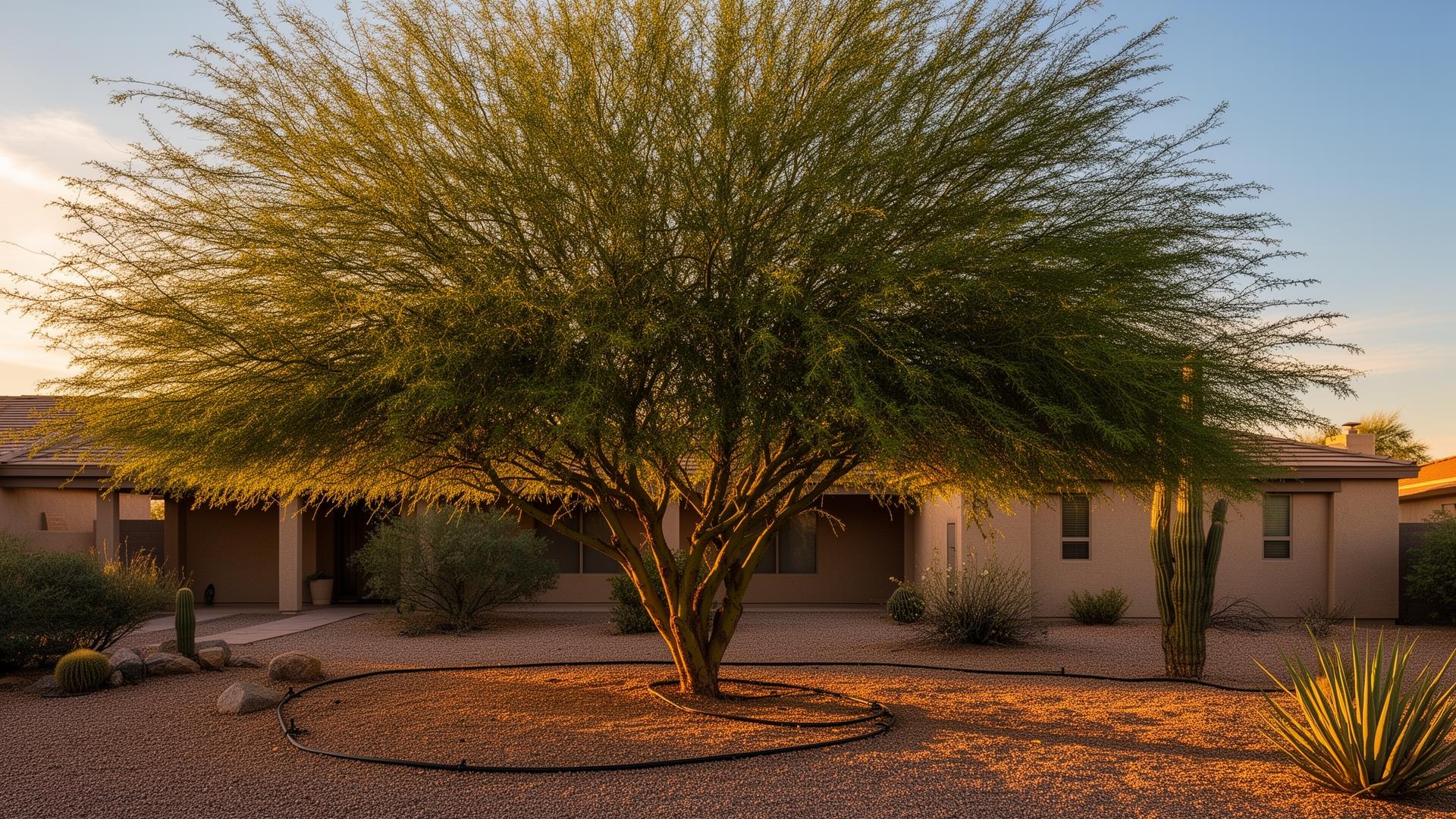
A Phoenix-specific watering schedule for velvet, honey, and Chilean mesquite trees — deep soaks, intervals, and the signs you're overdoing it.
If you're new to desert trees, the honest answer is: far less often, and far more deeply, than you think. A mature mesquite in Phoenix needs a slow, deep soak roughly every 3–4 weeks in summer and every 6–8 weeks the rest of the year — not a sprinkler tap every other day.
This guide gives you a month-by-month schedule, the differences between velvet, honey, and Chilean mesquites, the signs you're overwatering, and the exact way to deep-soak so the water actually reaches the roots that matter.
Want a personalized schedule for your tree's size, soil, and microclimate? Use the HolisticArborist watering calculator — it takes about 90 seconds.
Why mesquites need so little water
Mesquites evolved in the Sonoran Desert. Their taproots can reach 30–50 feet down chasing groundwater, and their lateral roots spread two to three times the canopy width. They're built to survive on infrequent, deep monsoon rains — not the daily trickle a turf irrigation system delivers.
When you water too often, two things happen:
- The deep roots stop growing down because the surface stays wet.
- The tree becomes top-heavy and shallow-rooted — and snaps in the first monsoon microburst. This is the #1 reason mesquites blow over in Phoenix.
Deep, infrequent watering trains the roots downward. That's the whole game.
Month-by-month watering schedule
These intervals assume a mature, established mesquite (3+ years in the ground) in average Phoenix soil. Newly planted trees need more frequent water for the first 1–2 years — see the section below.
| Month | Frequency | Soak depth | Notes |
|---|---|---|---|
| Jan | Every 6–8 weeks | 2–3 ft | Often skip entirely if winter rains hit |
| Feb | Every 6–8 weeks | 2–3 ft | Watch for new growth — that's your signal |
| Mar | Every 4–6 weeks | 3 ft | Spring push begins |
| Apr | Every 4 weeks | 3 ft | Heat is climbing |
| May | Every 3–4 weeks | 3 ft | Pre-summer deep soak |
| Jun | Every 3 weeks | 3 ft | Peak dry heat — most critical month |
| Jul | Every 2–3 weeks | 3 ft | Adjust for monsoon rain |
| Aug | Every 2–3 weeks | 3 ft | Same — let storms count |
| Sep | Every 3–4 weeks | 3 ft | Heat tapers |
| Oct | Every 4–6 weeks | 2–3 ft | Slow it down |
| Nov | Every 6–8 weeks | 2–3 ft | Dormancy approaching |
| Dec | Every 6–8 weeks | 2–3 ft | Often skip |
Rain credit: Anytime you get more than ½ inch of rain in a single storm, push your next watering back by 1–2 weeks. Monsoon downpours often count as a full deep soak.
Velvet vs honey vs Chilean: do they need different care?
The three common Phoenix mesquites have important differences for watering:
Velvet mesquite (Prosopis velutina) — Native to the Sonoran Desert. The most drought-tolerant of the three. Follow the schedule above as written; if anything, err toward less. A velvet mesquite that's watered weekly will grow fast, get top-heavy, and fail in a storm.
Honey mesquite (Prosopis glandulosa) — Native to Texas and northern Mexico. Slightly more tolerant of regular water but still desert-adapted. Same schedule as velvet — don't be tempted to water more just because it's leafier.
Chilean mesquite (Prosopis chilensis, often a hybrid) — The fast-growing thornless variety most homeowners have. Looks lush, which fools people into overwatering. This is the one that breaks in monsoons. Stick to the schedule strictly; if you live on a windy lot, lean toward the longer end of every interval.
How to deep-soak (the part that actually matters)
How you water matters as much as when. The goal is to wet the soil 2–3 feet deep across the drip line — the circle on the ground directly under the outer edge of the canopy. That's where the active feeder roots are, not at the trunk.
Method 1 — Hose on a slow trickle:
- Set your hose to a thin, steady stream (no spray).
- Place it at the drip line, not the trunk.
- Leave it for 45–90 minutes, then move it a quarter turn around the canopy.
- Repeat 4 times. Total time: 3–6 hours.
- Check depth with a long screwdriver or soil probe — it should slide in easily 2–3 feet down.
Method 2 — Drip system:
If you have drip emitters, run a long cycle (4–6 hours) at the drip line. Two short cycles a week is worse than one long cycle every three weeks. Reposition emitters outward as the tree grows — most homeowners leave them at the trunk forever, which is wrong.
Never:
- Water at the trunk. Encourages crown rot and shallow roots.
- Use lawn sprinklers as your only water source. They wet the top 6 inches and nothing more.
- Water at midday in summer. Early morning or evening only.
New tree (first 1–2 years)
A freshly planted mesquite needs more frequent water until its roots establish:
- First month: Every 3–4 days, deep soak.
- Months 2–6: Every 7–10 days.
- Months 6–12: Every 2 weeks, gradually stretching.
- Year 2: Every 3 weeks summer, every 4–6 weeks winter.
- Year 3+: Switch to the mature schedule above.
Stake a new mesquite loosely and remove stakes within 12 months. Permanent staking is another major cause of weak-rooted, storm-vulnerable trees.
Signs you're overwatering
Most struggling Phoenix mesquites are overwatered, not underwatered. Watch for:
- Yellowing leaves that drop while still green. Classic root-zone saturation.
- Sooty or black bark at the base. Bacterial wetwood or crown rot.
- Excessive fast, soft new growth that droops. Tree is being pushed too hard.
- Mushrooms or moss at the base. Soil never dries out.
- The tree leans more after every storm. Roots are shallow.
If you see these, skip the next two scheduled waterings and let the soil dry out. Then resume the schedule above, not your old one.
Signs you're underwatering
Real underwatering looks like:
- Small, crispy leaves curling at the edges
- Premature leaf drop with leaves turning fully brown
- Smooth, taut bark that begins to crack vertically
- New growth that wilts and doesn't recover overnight
Underwatered mesquites recover quickly from one good deep soak. Overwatered ones take months and sometimes don't.
Frequently asked questions
How long should I water my mesquite tree?
For a mature tree, a deep soak takes 3–6 hours total on a slow hose trickle, repositioned around the drip line. The total volume should wet the soil 2–3 feet deep — check with a soil probe or long screwdriver.
Can you overwater a mesquite tree?
Yes, easily. Overwatering is the leading cause of mesquite tree failure in Phoenix. It produces fast top growth with shallow roots, leading to storm damage and crown rot. Stick to deep, infrequent watering.
Should I water my mesquite in winter?
Usually only once every 6–8 weeks from November through February, and you can often skip entirely if winter rains have been normal. New trees still need water year-round.
How often should I water a newly planted mesquite?
Every 3–4 days for the first month, then stretch to every 7–10 days through month six, and every 2 weeks through the end of year one. By year three you're on the mature schedule.
Why is my mesquite tree dropping leaves in summer?
Two common causes: (1) heat-stress leaf shedding, which is normal and the tree will releaf, or (2) overwatering causing root saturation. Check the soil 12 inches down — if it's still moist 4+ days after watering, you're watering too often.
Get a schedule for your specific tree
The numbers above are good rules of thumb, but your soil, microclimate, and tree size change the math. The HolisticArborist watering calculator generates a custom schedule in about 90 seconds — including a printable card you can stick on the fridge.
You can also browse our full mesquite tree care page for pruning, fertilization, and pest guidance.
Get one watering tip per week
Short, seasonal, Sonoran-specific. No fluff. Unsubscribe anytime.